Skip navigation, go to main content
Orthodontics

Braces

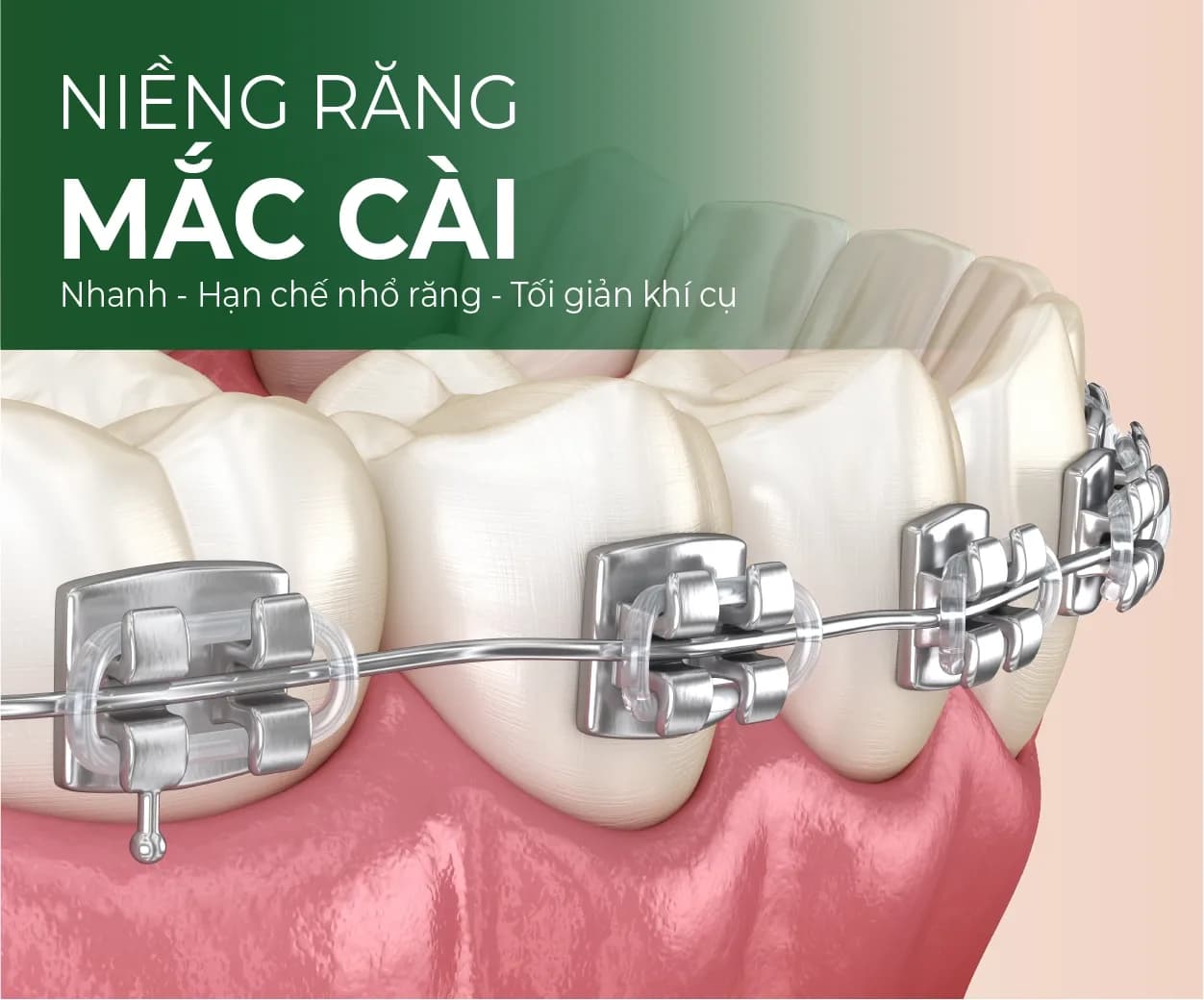
Braces use brackets fixed to the teeth together with an archwire to generate the force that moves them. This remains the most precisely controlled method for complex bite discrepancies, impacted teeth, and cases where teeth must travel a long distance.

Indicative cost

25,000,000 65,000,000 per case

Duration
18 – 30 months
Appointments
Review every 3 – 4 weeks
Anaesthetic
Not required
Warranty
Brackets and retainers
Braces at Dental Việt Nam

Braces at Dental Việt Nam costs from 25,000,000₫ to 65,000,000₫ per case, takes 18 – 30 months, and is warranted for brackets and retainers. Prices include VAT and are the same at every clinic; the initial examination and panoramic X-ray are free. It suits patients with significant crowding with a serious lack of space and protrusion or underbite of dental origin needing teeth moved a long way.

Who this is right for

  1. Significant crowding with a serious lack of space
  2. Protrusion or underbite of dental origin needing teeth moved a long way
  3. Impacted or ectopic teeth that must be brought into the arch
  4. Children and teenagers still growing
  5. Patients who would rather have a sensible cost than an invisible appliance

Who should not have this

  • Active periodontal disease not yet stabilised
  • Long-standing poor oral hygiene, with a high risk of decay around the brackets
  • Severe skeletal discrepancies needing combined orthognathic surgery

If you fall into this group, the dentist will propose a more suitable option rather than proceeding anyway. It is exactly why the first appointment always includes an X-ray.

The clinical detail

What to understand before deciding on Braces

Three points a dentist usually ends up explaining in the chair — read them first and your consultation can get straight to the point.

Teeth move because bone resorbs and rebuilds, which is why more force does not mean faster

When an archwire pushes a tooth, the side it moves towards is compressed and the bone there resorbs, while the opposite side is stretched and new bone is laid down. All of orthodontics rests on this biology.

That leads to a counter-intuitive consequence: too much force does not move a tooth faster. It crushes the blood vessels in the periodontal ligament, so the compressed area becomes avascular and the resorption process has to work around it — the tooth sits still for a while and then jumps, with more pain and a higher risk of root resorption.

So a correct protocol uses light continuous force, increased in stages with wires that progress from fine to heavy. The idea of tightening hard to get there sooner is a misconception, and it is why review appointments are 3 to 4 weeks apart rather than as often as possible.
Anchorage — what decides whether a protrusion case can actually be retracted

The basic law is that every force has an equal and opposite reaction. When you pull the front teeth back using the molars as the anchor point, the molars are pulled forward by a corresponding amount. That is anchorage loss, and it eats up exactly the space you had teeth extracted to create.

Severe protrusion needs virtually all of that space for retraction, so anchorage loss is not acceptable. A mini-screw — a small screw placed into the jawbone under local anaesthetic — creates an anchor point outside the dentition, allowing retraction without dragging the molars forward.

Placing one takes about 10 minutes and feels like an injection, and it is removed once it is no longer needed. In a dental protrusion case, the difference between having a mini-screw and not having one is often the difference between a clear result and a half-finished one.

Self-ligating brackets: genuinely faster, but not as fast as advertised

Conventional brackets hold the archwire with an elastic module, which creates friction and loses its elasticity over the weeks. Self-ligating brackets have a sliding door that holds the wire, reducing friction and keeping force more consistent between appointments.

The measurable practical benefit is a longer interval between reviews — 6 to 8 weeks rather than 3 to 4 — and less discomfort in the early phase. The claim that they halve the total treatment time has no basis: how long treatment takes is governed by bone biology and by the severity of the discrepancy, not by the type of wire retention.

In other words, self-ligating is a convenience worth paying for if you are busy or travel a lot — not a shortcut. Anyone selling you "self-ligating, done in 12 months" for a severe protrusion case is selling something biology does not allow.

What is different here

How we do Braces

Precise force control

The dentist adjusts each position directly through the archwire and elastics, handling complex cases that aligners struggle with.

Nothing depends on remembering to wear it

The brackets are fixed to the teeth, so progress is never set back by an appliance left out.

Three options by budget

Metal is the most economical, ceramic is more discreet, and self-ligating shortens chair time and spaces reviews further apart.

Mini-screws where anchorage is needed

In severe protrusion cases, a mini-screw provides a fixed anchor point so the front teeth can be retracted without anchorage loss.

The process

5 steps

You know in advance what happens and how long each stage takes.

Before you come in

The first appointment needs panoramic and cephalometric X-rays, so allow a full 60 minutes. If you have had orthodontic treatment before, bring your old records and films — they show how far the teeth have already moved and what condition the roots are in. Fillings, scaling and any planned extractions must be finished before bonding day. Expect 3 to 5 days of awkward eating at the start: buy soft food and dental wax before the appointment, not after.

  1. 01

    Examination, X-rays and impressions

    60 minutes

    Panoramic and lateral cephalometric X-rays, analysis of the skeletal, dental and soft-tissue relationship, and an orthodontic plan.

  2. 02

    Treatment before orthodontics

    1 – 3 appointments

    Scaling, fillings, and extraction of wisdom teeth or first premolars where the plan needs the space.

  3. 03

    Bonding the brackets

    90 minutes

    Brackets bonded to each tooth, an initial light archwire placed, and specific hygiene instructions given.

  4. 04

    Regular adjustment appointments

    18 – 30 months

    Wire changes and staged force increases, with mini-screws or inter-arch elastics added when needed.

  5. 05

    Debonding and retention

    60 minutes

    Brackets removed, teeth polished, and a fixed or removable retainer fitted to hold the result.

Aftercare

What to do at each stage

Most complications do not come from the treatment itself but from the days that follow. This is the guidance you are given when you leave.

3 – 5 days after each adjustment

Do

  • Soft, cool food; warm salt-water rinses
  • Dental wax over any bracket rubbing the cheek
  • Ordinary painkillers for the first day or two if needed

Avoid

  • Hard and chewy food while the teeth are still tender
  • Bending or cutting the archwire yourself at home

Daily hygiene throughout treatment

Do

  • Brush after every meal, at least three times a day
  • Use an interdental brush under the archwire and floss with a threader
  • A fluoride mouthwash every evening

Avoid

  • Skipping the inside surfaces — where plaque builds up most
  • Chewy sweets, hard sweets, ice, bones, crusty bread, corn on the cob
  • Chewing pens and biting nails

After debonding

Do

  • Wear the retainer exactly as prescribed, at night long term
  • Scale and polish immediately after the brackets come off
  • Check the fixed retainer every six months to make sure it is still attached

Avoid

  • Stopping the retainer because the teeth look straight
  • Ignoring new white spots — they need remineralisation treatment early
Cost

Braces and orthodontics price list

All-inclusive price for the full course of treatment, including appliances, adjustment visits and retainers.

Prices include VAT. The final cost depends on your specific case, is fixed in writing after the examination, and does not change part-way through.

Braces and orthodontics prices at Dental Việt Nam

  • Conventional metal braces25,000,000₫ per case

    Warranty: Full treatment

  • Self-ligating metal braces35,000,000₫ per case

    Warranty: Full treatment

  • Conventional ceramic braces40,000,000₫ per case

    Warranty: Full treatment

  • Self-ligating ceramic braces50,000,000₫ per case

    Warranty: Full treatment

  • Lingual braces (behind the teeth)65,000,000₫ per case

    Warranty: Full treatment

  • Invisalign First (children)45,000,000₫ per case

    Origin: USAWarranty: Full treatment

  • Invisalign Lite (14 aligners)65,000,000₫ per case

    Origin: USAWarranty: Full treatment

  • Invisalign Moderate (26 aligners)85,000,000₫ per case

    Origin: USAWarranty: Full treatment

  • Invisalign Comprehensive (unlimited aligners)135,000,000₫ per case

    Origin: USAWarranty: Full treatment

Five things that decide the final figure

  1. The type of bracket

    The main driver of the 25 to 65 million₫ range. The price is all-inclusive for the full course and is not charged per review appointment.

  2. Complexity and treatment duration

    Cases needing extractions, impacted teeth brought down, or more than 30 months of treatment require more appointments and more appliances than mild crowding does.

  3. Auxiliary appliances

    Mini-screws, expanders, and functional appliances for growing children are charged separately as indicated.

  4. Treatment before orthodontics

    Wisdom tooth removal, premolar extractions to create space, fillings and periodontal treatment are separate costs and must be completed first.

  5. Retainers after debonding

    The first set is included. A fixed retainer bonded behind the teeth and a removable one are usually used together; replacements after loss are chargeable.

Comparing the options

Four types of braces — choosing on budget and discretion

The mechanism that moves teeth is the same in all four. They differ in how visible they are, in friction, in durability and in price.

Four types of braces — choosing on budget and discretion
TypeDiscretionAdvantagesTrade-offsCost
Conventional metalClearly visibleMost durable, proven, least expensiveLeast discreet, reviews every 3 – 4 weeks25 million₫
Self-ligating metalClearly visibleFewer reviews, less discomfort, steadier forceSlightly bulkier brackets35 million₫
CeramicLess visibleClose to natural tooth colourMore brittle, higher friction, may add 2 – 4 months40 – 50 million₫
Lingual, behind the teethInvisibleThe appliance is completely hiddenFeels bulky to the tongue, affects speech at first, technically the most demanding65 million₫

The dentist's conclusion

If your work does not involve constant face-to-face contact, conventional metal braces remain the most effective option per unit of cost. Busy patients should consider self-ligating to cut the number of appointments. Ceramic makes sense where you want reasonable discretion at less than the cost of Invisalign. Lingual braces are for people who must hide the appliance completely and accept an uncomfortable adjustment period.

Risks

Possible complications and how they are prevented

No medical technique carries zero risk. What makes the difference is knowing in advance where the risk sits and controlling it with a specific protocol.

White spot demineralisation around the brackets

Cause
Plaque left around the base of the brackets for months, demineralising the enamel — the most common complication of fixed braces.
Prevention
Brush after every meal with an interdental brush, use high-fluoride toothpaste as prescribed, and have fluoride applied at the clinic regularly. White spots that have already formed do not disappear on their own.

Root resorption

Cause
Excessive force, long movements, or individual susceptibility — most often affecting the front teeth.
Prevention
Light continuous force, a comparison X-ray mid-treatment, and slowing or stopping where early root resorption appears.

Gum recession with exposed root surface

Cause
Pushing teeth outward beyond the limits of the alveolar bone, typically in patients with a thin bone plate or uncontrolled gum disease.
Prevention
Assess bone and gum thickness before treatment, stabilise periodontal disease before bonding, and expand within biological limits.

Debonded brackets and broken wires causing pain

Cause
Eating hard, chewy or sticky food, or tearing food with the front teeth.
Prevention
Cut food up, avoid the food groups you are told to avoid, cover a poking wire with dental wax, and come in rather than trying to fix it yourself.

Relapse after debonding

Cause
Stopping retainer wear early, particularly in cases with heavily rotated teeth or closed spaces.
Prevention
Combine a fixed retainer bonded behind the teeth with a removable one at night, and have the retainer checked annually.
Frequently asked

Questions about Braces

On average 18 to 30 months depending on the severity. Mild crowding can finish in 12 to 15 months; severe protrusion needing extractions and mini-screws usually runs beyond 24 months.

Book today,
and find out exactly where your teeth stand

A dentist examines you, takes a panoramic X-ray and explains what it shows using your own images. Free, even if you decide not to go ahead.

Open Monday – Sunday · 08:30 – 20:00 · Clinic in Hanoi

Zalo